Toyota to bring 750 jobs to Kentucky

Written By limadu on Jumat, 19 April 2013 | 22.16

toyota akio toyoda

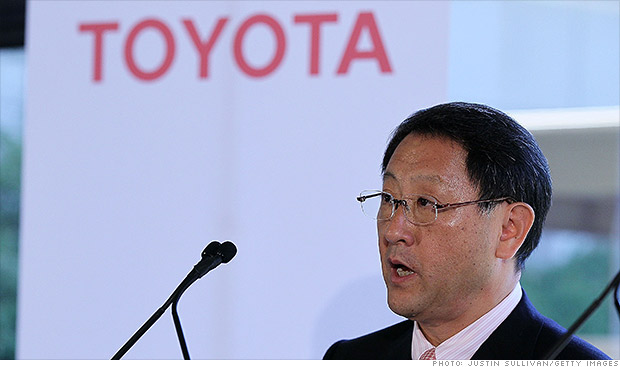
Toyota Motor president Akio Toyoda, shown here in an image from 2010, announced Friday that the company is bringing Lexus production to Kentucky, adding 750 jobs.

NEW YORK (CNNMoney)

Toyota Motor (TM) President Akio Toyoda announced that the company would build the Lexus ES sedan at the Kentucky plant where Toyota currently builds Camry, Camry Hybrid, Avalon Hybrid and Venza models.

"Lexus was founded in the United States, so it is only fitting that we are bringing the production of luxury sedans for our U.S. customers back to where the brand was born," said Toyoda, in a press conference.

Related: Car makers take Silicon Valley

The company does not currently build any Lexus models in the United States. It plans to begin making Lexus cars at the plant in 2015, adding 50,000 vehicles per year to the factory's production.

In a bid for the expansion, Kentucky gave Toyota nearly $150 million in state and local tax incentives, according to state documents.

The company said it is investing $360 million in into the factory.

Related: Remington jobs rule the Rust Belt

The state unemployment rate currently stands at 7.9%, slightly higher than the national average of 7.7%. Scott County, where the plant is located, has an unemployment rate of 7%.

The plant is located on a 1,300-acre plot, and has a capacity to build 500,000 vehicles and engines, making it Toyota's first and largest factory in North America, according to state documents. To top of page

First Published: April 19, 2013: 10:10 AM ET


22.16 | 0 komentar | Read More

Stocks mixed as investors watch Boston lockdown

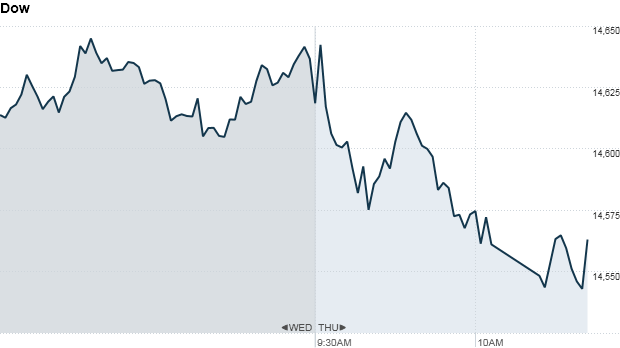
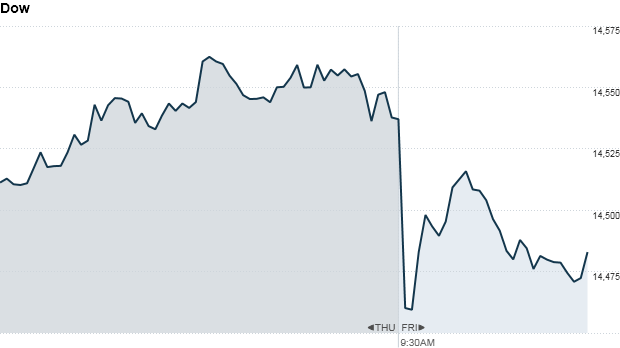
Dow 10:14 am

Click chart for more markets data.

NEW YORK (CNNMoney)

It appears to be a relatively quiet day on Wall Street so far, as traders were glued to the latest events in Boston, which remains in lockdown mode as police hunt for a suspect in the Boston Marathon bombings.

Concerns about the health of the sector pushed down the Dow. Shares of IBM (IBM, Fortune 500) dropped more than 6% Friday following weak earnings. IBM has the biggest weighting in the Dow.

Yet the S&P 500 and the Nasdaq ticked higher.

Mixed bag of earnings reports: Some of the world's biggest companies handed investor big surprises, but no easy takeaways on the broader health of corporate America.

"No broader trend has emerged yet," said BTIG's chief market strategist Dan Greenhaus. "A lot of what we have seen is company specific."

Related: Fear & Greed Index stuck in fear

Take industrials. General Electric (GE, Fortune 500) spooked investors by noting its big backlog of equipment and services. its stock fell 4%.

Yet appliance maker Honeywell (HON, Fortune 500) reported an increase in first quarter earnings, pushing up its stock price by 3%.

And Big Macs are not so hot. McDonald's (MCD, Fortune 500) shares dropped after the hamburger maker noted a decline in same-store sales.

But Chipolte's (CMG) - one of hedge fund manager David Einhorn's least favorite stocks -- rose 5% after reporting earnings on Thursday that showed increases in revenue, income and same-store sales.

The contrasting reports continued in the tech sector. While IBM fell drastically, other tech stocks fared better. Microsoft (MSFT, Fortune 500) got a big boost in its latest earnings report from strong Windows 8 sales, pushing up its stock 4%.

Google (GOOG, Fortune 500) earnings topped estimates, even as the search giant faces challenges with how to make money off mobile ads and its Motorola smartphone unit. The company's stock rose nearly 2% .

Analysts expect earnings for S&P 500 companies to rise by 1.85% for the first quarter, according to S&P Capital IQ. But earnings season is far from over. So far, 91 S&P 500 companies have reported, with 64 beating forecasts, 19 missing and 8 coming in in line.

Apple finally rebounds? Shares of Apple (AAPL, Fortune 500), which have been in freefall lately, ticked slightly higher in mid-morning trding after hitting another new 52-week low earlier Friday.

Meanwhile, Dell's (DELL, Fortune 500) stock fell more than 3% following reports that Blackstone (BX) dropped its bid to buy the computer company.

Shares of PepsiCo (PEP, Fortune 500) and Mondelez (MDLZ) rose 2%. According to CNBC, activist investor Nelson Peltz has been raising his stake in PepsiCo and Mondelez. Analysts expect Peltz and his fund Trian will push for a merger between the two or a combination of some of their food and snack businesses.

SeaWorld (SEAS) debuted Friday with the amusement park operator's stock jumping nearly 15%.

Related: Bitcoin bubble re-inflates

European markets were mixed in afternoon trading, led by the CAC 40 in Paris with a gain of 1%, while Asian markets also ended firmer. The Shanghai Composite closed up 2.1%, Hong Kong's Hang Seng up 2.3% and Japan's Nikkei up 0.7%.

The dollar fell against the euro and the pound, but edged higher versus the Japanese yen.

Oil and gold prices edged higher.

The price on the 10-year Treasury fell, pushing the yield up to 1.70%. To top of page

First Published: April 19, 2013: 9:52 AM ET

22.16 | 0 komentar | Read More

March of the penguins: SeaWorld surges 16%

seaworld public trading

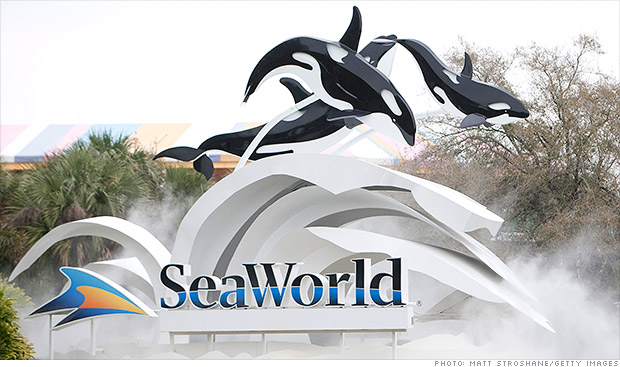
Who doesn't love Shamu? Investors do. SeaWorld made a big splash with its initial public offering.

NEW YORK (CNNMoney)

Shares of the beloved killer whale's parent company SeaWorld Entertainment (SEAS) surged more than 16% on their debut on the New York Stock Exchange, where penguins, an otter and a lemur walked through the trading floor.

Backed by private equity firm Blackstone Group (BX), the amusement park giant raised $702 million by offering 26 million shares at $27 a piece, the top of its expected range. At that price, SeaWorld's market value comes in at about $2.5 billion. Blackstone bought SeaWorld from brewing giant Anheuser-Busch InBev (BUD)in 2009.

With the proceeds from the offering, the company plans to pay down some of its debt, said SeaWorld CEO Jim Atchison in an interview with CNN at the New York Stock Exchange.

SeaWorld is also preparing for the opening of Antarctica: Empire of the Penguins at its Orlando theme park next month. Atchison, who began his career at the company nearly three decades ago as a parking attendant, said Antarctica will be home to 250 penguins and is one the company's most ambitious attractions.

Related: The IPO market's hottest craze: Dividends

The company, which operates a total of 11 theme parks including three SeaWorld locations as well as Busch Gardens, said it will pay shareholders a dividend of $0.80 a year, for a dividend yield of about 3%. Though dividends aren't typically associated with the IPO market, a growing number of newly public companies are making quarterly payouts.

Under Blackstone's ownership since late 2009, SeaWorld has increased its revenue and profits. In 2012, the company posted a 7% jump in revenue to $1.4 billion and a more than quadrupled its profit to $77.5 billion compared to the prior year.

Rival theme parks Six Flags (SIX) and Cedar Fair (FUN) were also higher in early trading Friday. And both have had strong runs so far in 2013, with Six Flags shares up more almost 20% and Cedar Fair's stock up almost 25%. To top of page

First Published: April 19, 2013: 10:14 AM ET


22.16 | 0 komentar | Read More

What type of consumer are you?

Written By limadu on Kamis, 18 April 2013 | 22.16

consumer classification acxiom

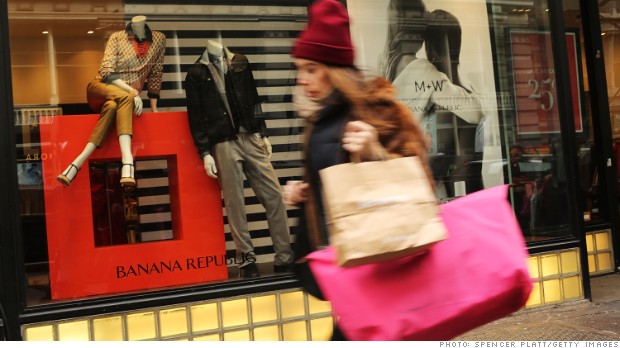
City Mixers tend to be single, city dwellers who shop at Banana Republic.

NEW YORK (CNNMoney)

Using its massive database filled with personal data on shoppers and their buying behaviors, data giant Acxiom places each of the U.S. households it tracks into one of 70 categories, ranging from the wealthiest -- dubbed "Summit Estates" -- to the bottom of the income spectrum -- or "Resilient Renters."

According to Acxiom's marketing materials, the "clusters" allow "marketers to better know -- and anticipate -- their customers' demographics and buying behaviors." And the categories help retailers decide the location for a new store, for example, which television stations to advertise on, or which customers they should market a new product line to.

But critics say that the groupings can result in biases toward different shoppers, often based on socioeconomic factors like income.

"It's really being put into a box," said Pam Dixon, executive director of the World Privacy Forum. "And that's the problem."

Wondering where you fall? Here's how Acxiom describes various types of consumer households in its marketing materials:

Married Sophisticates: You're in your late 20s or early 30s, recently married and likely have a household income between $50,000 and $100,000. You probably own a home, most likely in an upscale suburban neighborhood. You're a fan of "green and trendy cars," shop at Banana Republic (GPS, Fortune 500) and The Gap (GPS, Fortune 500) and are a loyal Netflix Inc (NFLX) subscriber.

Truckin' & Stylin': You're in your 30s or 40s, live in a rural town and earn a moderate income. You may be married, but you don't have any children. You shop at stores like Wal-mart (WMT, Fortune 500) and AutoZone and enjoy watching NASCAR and classic shows on TV Land.

Collegiate Crowd: Between 18 and 23 years old, you're single and highly mobile. You're likely a renter and probably live in a college town. You buy clothes from American Eagle (AEO) and Express Inc (EXPR) and are a frequent liquor store patron. Your TV is tuned to Family Guy and you probably have copies of Rolling Stone and Us Weekly lying around.

Shooting Stars: You're in your 30s or 40s, married without any kids. You enjoy a six-figure household income and likely have a graduate degree. You shop at stores like Ann Taylor (ANN ) and Sephora, read magazines like Men's Health and Real Simple and use the web to check your stock investments and make travel plans.

Apple Pie Families: You're part of an upper-middle class family, likely living in a smaller city or nearby suburb. You probably drive a minivan. You shop at stores like Home Depot (HD, Fortune 500), Target (TGT, Fortune 500)and Best Buy (BBY, Fortune 500), read Sports Illustrated and listen to NPR.

City Mixers: You're a childless, single "urbanite" living in a city like New York, Los Angeles or Chicago. Well-educated, you likely enjoy museums and the theater. You buy groceries from Trader Joe's and Whole Foods, outfit your home with Crate & Barrel and buy clothes from Banana Republic. You read The New York Times (NYT) and watch The Office.

Related: Facebook uses offline purchases to target ads

Metro Parents: You're a single parent living in a city, likely on an income of less than $50,000. You shop at Kmart (SHLD, Fortune 500) and Payless ShoeSource, read magazines like Ebony and Seventeen and watch soap operas and BET.

Timeless Elders: You're a retiree, likely living alone on a modest income. You are active in your community, frequently clip coupons and shop primarily at discount stores like Kmart. Your favorite TV shows include The Price Is Right, Wheel of Fortune and 60 Minutes. To top of page

First Published: April 18, 2013: 9:54 AM ET


22.16 | 0 komentar | Read More

Stocks continue to retreat

u.s. stocks, dow

Click the chart for more stock market data.

NEW YORK (CNNMoney)

The Dow Jones industrial average and the S&P 500 declined 0.3% while the Nasdaq dropped 0.5%.

Financial and technology stocks were big laggards.

Morgan Stanley's (MS, Fortune 500) reported better-than-expected earnings and revenue, but weakness in traditional trading revenue pushed shares down 4%. Bank of America (BAC, Fortune 500), which tumbled nearly 5% Wednesday after missing first-quarter earnings estimates, sank another 3% Thursday, making it the biggest loser on the Dow.

Related: Fear and Greed Index flashing fear signals

On the tech front, Nokia's (NOK) stock price dropped 12% after the Finnish cell phone company reported a 20% drop in quarterly sales.

eBay (EBAY, Fortune 500) shares were the biggest drag on the Nasdaq, falling 4% after the online-auction site issued weak second-quarter guidance. And while SanDisk (SNDK, Fortune 500) reported better-than-expected earnings and sales for the first-quarter, shares of the company also declined 3%.

Apple's (AAPL, Fortune 500) shares remained under pressure a day after its stock fell nearly 6%. Shares fell to $395.27, the lowest since November 2011. Apple was most recently hampered by a negative sales forecast from iPhone supplier Cirrus Logic (CRUS).

Techs will remain in focus, as IBM (IBM, Fortune 500), Google (GOOG, Fortune 500) and Microsoft (MSFT, Fortune 500) are all scheduled to report earnings after the close.

While technology stocks were largely weighing on the broader market, Verizon (VZ, Fortune 500) was bucking the trend. Shares of the company jumped more than 3% after it beat earnings forecasts.

Also on the bright side, PepsiCo (PEP, Fortune 500) shares climbed 5% on better-than-expected quarterly earnings.

Shares of Carnival Corp.'s (CCL) rose after the cruise ship company said it planned to invest more than $600 million into fixing its disaster-prone toilets.

Related: I lost $50K in Bitcoin crash, but I'm still a believer

In economic news, the government said initial jobless claims increased by 4,000 to 352,000 in the week ended April 13. That was slightly below forecasts.

European markets rose in afternoon trading, as the German parliament reportedly backed a €10 billion bailout for Cyprus.

Asian markets ended mixed. The Shanghai Composite added 0.2%, while the Hang Seng declined 0.4% and the Nikkei lost 1.2%.

The dollar fell against the euro and the pound, but edged higher versus the Japanese yen.

Oil and gold prices edged higher.

The price on the 10-year Treasury rose, pushing the yield down to 1.69% from 1.70% late Wednesday. To top of page

First Published: April 18, 2013: 9:45 AM ET


22.16 | 0 komentar | Read More

Verizon iPhone sales tumble 33%

Verizon iPhone 5 Line

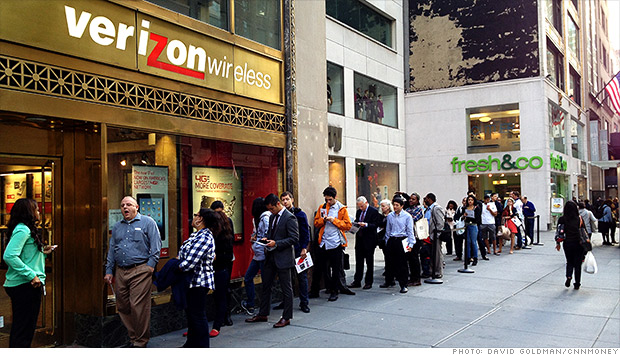
Verizon's first-quarter iPhone sales fell by a third over the fourth quarter.

NEW YORK (CNNMoney)

Verizon's iPhone activations fell 33% in the first quarter, compared to the fourth quarter. Though the first quarter can serve as a tough comparison to the prior three months -- the stretch each year during which Apple typically releases its new smartphones -- the drop is considerably steeper this time than it was last year.

Last year, Verizon's first-quarter iPhone activations fell by 24% from the fourth quarter.

The nation's largest wireless carrier said it activated 4 million iPhones over the past three months, 2 million fewer than the 6 million it sold between September and December 2012.

Verizon (VZ, Fortune 500) said just over half (55%) of the 7.2 million smartphones it activated last quarter were iPhones. That's down from 64% in the previous quarter.

That doesn't spell doom for the iPhone, but there is cause for Apple (AAPL, Fortune 500) to be concerned

Related story: The iPhone 5 may be Apple's last blowout U.S. bestseller

Just half of Verizon customers who bought iPhones during the first quarter bought the latest model, the iPhone 5.

The steep $100 and $200 discounts on Apple's older devices, the iPhone 4S and iPhone 4, are the likely culprit. Though each new version has brought some helpful tweaks -- including faster processors, larger screens and the Siri voice-controlled assistant -- the iPhone 5 isn't dramatically different from the iPhone 4, which was released in 2010.

Apple, which will report its quarterly results on April 23, has disappointed Wall Street investors lately with lower-than-expected iPhone sales -- even as it sold a record 48 million of the devices in the fourth quarter. In the market-share battle, Apple still trails smartphones running Google's Android smartphone operating system by a wide margin.

It's also possible that customers are becoming smarter about when to buy the iPhone. Apple has consistently released its new smartphone in the late summer or early fall, and consumers seem to be catching onto that trend. IPhones are now setting records in the fourth quarter, then taking an increasingly steep quarter-over-quarter dive in the first three months of the new year, when other device makers begin to show off their new toys.

Related story: Apple needs the iTV soon

The beneficiary of this trend appears to be the wireless carriers. Carriers pay more money upfront to Apple to subsidize the iPhone than they pay other smartphone makers for rival devices.

Verizon reported a 50.4% wireless profit margin in the first quarter, up sharply from its record low 41.4% margin in the fourth quarter. When it sells fewer iPhones, Verizon performs better -- in the near-term, anyway.

That's been the trend for Sprint (S, Fortune 500) and AT&T (T, Fortune 500) as well. Both of Verizon's prime rivals will report their quarterly finances next week. T-Mobile also began selling the iPhone for the first time this month. To top of page

First Published: April 18, 2013: 10:51 AM ET


22.16 | 0 komentar | Read More

Sprint shareholder John Paulson backs Dish offer

Written By limadu on Rabu, 17 April 2013 | 22.16

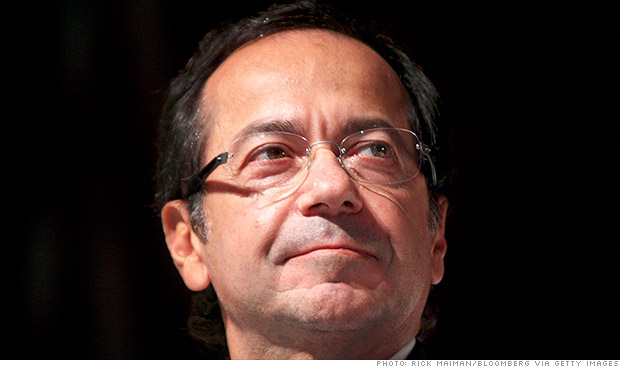
John Paulson became the first major Sprint Nextel shareholder to back the offer for the company from Dish Networks.

NEW YORK (CNNMoney)

The prominent hedge fund manager said in a statement that the $25.5 billion cash-and-stock offer from Dish was superior to an offer for 70% of the company from Japanese tech giant Softbank.

"Dish is offering more value to Sprint shareholders and also is contributing valuable spectrum, 14 million subscribers, cost synergies and revenue synergies," Paulson said in his statement.

Dish (DISH, Fortune 500) unveiled the unsolicited bid early Monday. Sprint Nextel (S, Fortune 500) has said that its board is weighing the offer.

Dish Chairman Charlie Ergen argued that the combination would be able to use available spectrum that Dish owns to give customers the access to wireless data, particularly video, that they want. Dish has amassed a large portion of wireless spectrum from the Federal Communications Commission that it must use for a wireless service within the next seven years or its license will expire.

Related: Dish-Sprint merger success no sure thing

Paulson's hedge fund, Paulson & Co., purchased 127.7 million shares of Sprint Nextel during the fourth quarter, according to the firm's filings. That represents 4.5% of Sprint's outstanding shares.

According to share tracker LionShares, Paulson & Co. is the fourth-largest shareholder in Sprint, while Sprint is Paulson & Co.'s fourth-largest equity holding.

This has been a busy week for Paulson and his firm's holdings.

His holdings in gold have taken an estimated $1 billion hit due to a plunge in gold prices, although he bought the commodity at a low enough price to still be profitable.

However, Paulson's holding of 14 million shares in Life Technologies (LIFE) jumped 8% after the biotech company agreed Monday to be purchased by Thermo Fisher (TMO, Fortune 500) for $13.6 billion. Life Technologies is Paulson's second-largest equity holding. To top of page

First Published: April 17, 2013: 10:05 AM ET


22.16 | 0 komentar | Read More
techieblogger.com Techie Blogger Techie Blogger