Zipcar's weekend crush solution: Merge with Avis

Written By limadu on Rabu, 02 Januari 2013 | 22.17

NEW YORK (CNNMoney)

The companies said Wednesday that Avis (CAR, Fortune 500) has agreed to buy Zipcar (ZIP) for about $500 million, or $12.25 per share in cash, which is nearly 50% above the closing price of Monday.

Zipcar's stock surged in premarket trading to match Avis' valuation.

Avis said that it plans to use its fleet of rental cars to beef up Zipcar for its weekend demand, "which is currently constrained by fleet availability."

As a "car sharing" company, Zipcar operates under a slightly different model, appealing to customers who would rather rent a car by the hour, instead of by the day, though it offers services for both. Avis and Budget offer rentals on a daily or weekly basis.

The deal requires final approval from Zipcar shareholders. Avis and Zipcar expect the deal to be completed in the spring.

Citigroup (C, Fortune 500) is the financial adviser for Avis. Morgan Stanley (MS, Fortune 500) is the financial adviser to Zipcar.

To top of page

First Published: January 2, 2013: 7:08 AM ET


22.17 | 0 komentar | Read More

U.S. credit ratings test is yet to come

The fiscal cliff deal is unlikely to trigger immediate U.S. ratings change

LONDON (CNNMoney)

The New Year agreement between the White House and Congress raised taxes on the richest Americans but postponed much of the toughest political wrangling on automatic spending cuts for another two months.

Also, the bill does not address the $16.4 trillion debt ceiling, which was hit on Monday. Instead, the Treasury Department will deploy "extraordinary measures" to allow additional borrowing of about $200 billion, in effect buying the United States about two months to raise the official limit.

The last time Congress negotiated the debt ceiling it prompted Standard & Poor's to strip the country of its coveted AAA credit rating. The agency criticized ineffective decision-making in Washington and the lack of a plan to stabilize the country's debt in the medium term.

S&P said in late December it still held that view, and repeated a warning that the United States could face another downgrade by 2014, or sooner, if Congress doesn't come up with a plan to reduce the national debt.

Related: Fiscal cliff deal boosts world markets

Fitch and Moody's both kept their top AAA ratings in place after the S&P downgrade but have warned of the risk of downgrades.

Moody's said in September a downgrade was likely if lawmakers were unable to agree on a long-term debt reduction plan.

"Failure to reach even a temporary arrangement to prevent the full range of tax increases and spending cuts implied by the fiscal cliff and a repeat of the August 2011 debt ceiling episode would indicate that the general election had not resolved the political gridlock in Washington and would probably result in a sovereign rating downgrade," Fitch said last month.

With a temporary agreement now in place, and the debt ceiling debate deferred, an imminent downgrade seems unlikely. But the threat hasn't gone away.

"Failure to reach agreement on raising the debt ceiling in a timely manner -- weeks in advance rather than just a single day before the funding capacity of the federal government is exhausted as happened in August 2011 -- would raise questions about US governance on fiscal matters and undermine confidence in the United States as a reliable borrower and prompt a formal review of the U.S. rating," Fitch said in its global sovereign outlook.

The impact any further downgrades would have, however, remains unclear. U.S. borrowing costs fell following S&P's 2011 move, and a similar pattern has been seen when other AAA-sovereigns have suffered the same fate. Yields on French government bonds have declined since it lost its AAA rating from Moody's in November. To top of page

First Published: January 2, 2013: 8:51 AM ET


22.17 | 0 komentar | Read More

Stocks rally into 2013

Lawmakers have agreed to a fiscal deal that raises taxes on Americans earning more than $400,000 a year, and delays automatic spending cuts until March 1.

NEW YORK (CNNMoney)

The Dow Jones Industrial Average rallied more than 230 points, or 1.7%, shortly after the opening bell. The S&P 500 rose 2%, while the Nasdaq spiked more than 2.6%.

The market's early gains were broad, with shares of Apple (AAPL, Fortune 500)and Bank of America (BAC, Fortune 500) both rising 4%. United States Steel (X, Fortune 500) jumped 5%.

As investors shifted into riskier assets, safe havens, such as U.S. Treasuries sold off, with the yield on the 10-year note rising to 1.84% - a level not seen since mid-October.

Oil and gold prices also posted sharp gains.

Investors cheered the late night deal reached by the House that keeps the Bush tax cuts in place for most Americans, but raises the tax rate on individuals earning more than $400,000 and married couples earning over $450,000.

Lawmakers allowed the payroll tax cut to expire but extended federal emergency unemployment insurance benefits for another year.

Related: 3 more fiscal cliffs loom

Investors ignored any downsides to the deal, including Congress's failure to tackle automatic spending cuts, which are now set to go into effect March 1. Additional -- and perhaps more intractable -- challenges remain. Congress must soon raise the debt ceiling, and figure out plans for the postponed spending cuts and the federal budget.

"Congress has done the easy part," said Lewis Alexander, chief U.S. economist for Nomura, in a research note. "Now a new Congress will have to tackle the hard part -- reduce long-term spending, raise additional revenue and increase the debt limit."

Fear & Greed Index

All major global markets were closed Tuesday for the New Year's holiday -- but many overseas markets posted strong gains Wednesday after news of the deal broke.

European markets were broadly higher in early trading, posting gains of more than 2%. Asian markets ended higher. Australia's ASX All Ordinaries index added 1.3%. South Korea's KOSPI gained 1.7% and the Hang Seng in Hong Kong advanced 1.9%.

Japan's Nikkei and the Shanghai Composite remain closed in an extended New Year's holiday.

Related: Stocks in 2013: Get defensive

Aside from weighing the deal's impact, investors will get some economic data to consider after the opening bell.

At 10 a.m. ET, the Institute for Supply Management will release its monthly manufacturing index for December, and the Census Bureau will release its data on construction spending in November.

In company news, Avis Budget Group (CAR, Fortune 500) announced it will acquire Zipcar for $12.25 a share -- a 49% premium over its closing price on Monday. Zipcar (ZIP) shares rose nearly 50%.

To top of page

First Published: January 2, 2013: 9:47 AM ET


22.17 | 0 komentar | Read More

Senate bill stops many tax hikes, but leaves big issues pending

Written By limadu on Selasa, 01 Januari 2013 | 22.16

NEW YORK (CNNMoney)

Most prominently, it would extend the Bush-era tax cuts for the vast majority of Americans and spare tens of millions from the Alternative Minimum Tax.

But the deal, crafted over the long weekend by Vice President Joe Biden and Senate Minority Leader Mitch McConnell, still must be approved by the House.

And while it would provide some short-term certainty, it would leave a range of big issues unaddressed.

For instance, when and how will lawmakers raise the country's debt ceiling? From all indications, the coming fight in February could be ugly.

The legislation also creates a new cliff deadline over spending cuts around the same time the debt ceiling will need to be raised.

And what about real tax and entitlement reform? Both are key to long-term deficit reduction, but neither are included in the compromise proposal.

Instead, according to sources familiar with the deal and the text of the bill, the Biden-McConnell compromise would:

Make most Bush tax cuts permanent: The Bush-era income tax rates would be permanently extended for all income up to $400,000 ($450,000 if married). Bush tax cuts that apply to income above those levels would expire.

Effectively that means for households above those thresholds, their top rate would rise to 39.6%, up from 35% in 2012.

Plus, the capital gains and dividend tax rates for these high-income households would increase to 20% from 15%. For everyone else, investment tax rates would remain at 15% or below.

The compromise bill would also preserve the expanded parameters for the American Opportunity Tax Credit, the Child Tax Credit and Earned Income Tax Credit for 5 more years.

Permanently protect the middle class from the AMT: The bill would permanently adjust the income exemption levels for the Alternative Minimum Tax for inflation.

Most immediately, the measure would prevent close to 30 million middle-class taxpayers from having to pay the so-called wealth tax for 2012.

Without a patch for 2012 in place soon, the IRS has warned lawmakers that up to 100 million taxpayers may not be able to file their 2012 taxes until late March and their refunds would be delayed.

Passing an AMT patch with an extension of the Bush tax cuts on most income -- which together make up the biggest piece of the fiscal cliff -- would boost real GDP by about 1.25% in fiscal year 2013, according to earlier Congressional Budget Office estimates.

Related: Fiscal Cliff: What's in the deal ... what could have been

Cap itemized deductions on high-income households: The Biden-McConnell compromise would cap how much those making $250,000 (married couples making $300,000) may take in itemized deductions.

Retain key tax incentives for businesses: The bill would extend for two years several tax breaks for businesses, including a production tax credit for developers of wind projects, the research and development tax credit, and a measure allowing for bonus depreciation.

Retains several expired tax breaks for individuals: The compromise bill would extend for one or two years a few "temporary" tax breaks for individuals that regularly are extended. These include an option to deduct state and local sales taxes in place of state and local income taxes; and a deduction for elementary and secondary school teachers for certain expenses.

Permanently extend a more lenient estate tax: The legislation would preserve the current estate tax exemption level of $5.12 million but index it to inflation for future years. And it would raise the top rate to 40% from 35% currently.

If the deal is not approved, the estate tax bite would be much bigger because the exemption level is scheduled to fall to $1 million and the top rate would rise to 55%.

Extend benefits for the long-term unemployed: The bill would continue a federal extension of unemployment benefits for one year.

Without it, more than 2 million of the long-term unemployed would run out of benefits at the end of this year, according to the National Employment Law Project, an advocacy group.

Continuing the benefit extension for one year would cost an estimated $30 billion.

Prevent a cut in Medicare doctors' pay: The Biden-McConnell compromise would prevent a scheduled 27% cut in reimbursement for Medicare services for one year. The so-called "doc fix" would boost the deficit by $31 billion.

Replace sequester for 2 months: The dreaded sequester -- the automatic and blunt spending cuts to defense and nondefense programs -- would be replaced for two months in 2013.

The two months of cuts would be replaced by $12 billion in new revenue and $12 billion in spending cuts.

It's not clear what Congress will decide to do about the sequester after the two months are up. If left in place for the whole year, the sequester would have reduced spending authority in 2013 by roughly $110 billion. To top of page

First Published: January 1, 2013: 2:26 AM ET


22.16 | 0 komentar | Read More

Families worried about their tax credits

The Shivers family stands to lose thousands of dollars worth of tax credits next year unless Congress takes action.

NEW YORK (CNNMoney)

Charlie and Jessica Shivers currently receive a Child Tax Credit of about $1,000 for each of their two children. But if Congress fails to extend the credit as it stands, that will drop to no more than $500 each.

And it doesn't stop there. Jessica works as a stay-at-home mom. But Charlie, a federal employee, earns about $84,000 so has received an annual $1,700 boost from the payroll tax cut passed in 2010. But that extra money is likely to disappear because Congress is not expected to extend the tax cut.

Many families like the Shivers could also end up worse off by hundreds or thousands of dollars next year if a deal to avert the fiscal cliff isn't reached.

Four of the biggest tax breaks for families on the chopping block are the Child Tax Credit, Earned Income Tax Credit, Child and Dependent Care Credit and the American Opportunity Credit. All are scheduled to revert to lower levels with the start of the new year.

Meanwhile, the expiration of the payroll tax cut would cause paychecks to shrink for 160 million working Americans, regardless of whether they have children.

Related: Parents await fate of four key tax breaks

The bill passed by the Senate early Tuesday would extend three of these credits, but the legislation still must be approved by the House.

For the Shivers, losing $2,700 would mean a cutback in spending. They would delay home improvements, take fewer road trips to see their family and eat out less often.

"As far as being a consumer, we're going to cut back significantly," he said.

It would also stunt the progress they've made paying off their student loan debt, and they wouldn't be able to put as much money into retirement and college savings.

The tax hit wouldn't be "the difference between putting food on the table or not," but it would definitely "still hurt", said Charlie.

Related: Why your paycheck will shrink, no matter what

Another parent, Linda Sadlouskos, is frustrated that she may not be able to take advantage of the American Opportunity Tax Credit, which is scheduled to revert to the Hope Credit and drop from a maximum of $2,500 to $1,800. It would also no longer be refundable, and it would be available for only two years rather than four.

Her son is attending the University of Medicine and Dentistry of New Jersey this year, and she makes too much to qualify for need-based grants.

"My family income is too high for him to have ever qualified for any outright grants, so this is the only form of assistance we would receive toward his education," she said. "Since I'm a single mom trying to get him his education, every bit helps, because we're on a pretty tight budget."

But most of all, she said it's "unforgivable" that Congress can't get its act together and that parents like her have been left not knowing what to expect going into the new year.

"It seems really callous of all of our lawmakers to be leaving us hanging on New Year's like this," she said. "This is no way to treat the public." To top of page

First Published: December 31, 2012: 6:31 PM ET


22.16 | 0 komentar | Read More

3 more fiscal cliffs loom

If Congress passes the fiscal cliff deal at hand, lawmakers will face three more budget deadlines over the next three months. Get ready for the debt ceiling, the sequester part II and the continuing resolution.

NEW YORK (CNNMoney)

That's what's in store if Congress adopts the deal under consideration. The bill approved by the Senate early Tuesday doesn't address the debt ceiling and temporarily puts off most of the automatic spending cuts otherwise set to take effect Wednesday.

Assuming it passes the House, here is what's still ahead:

1. Debt Ceiling: Congress has to raise the debt ceiling soon. Real soon.

On Monday, Treasury Secretary Tim Geithner made it official: Federal borrowing has reached the $16.394 trillion debt ceiling.

The Treasury Department, which runs the government's debt-issuance operation, can create about $200 billion of headroom by employing what it calls "extraordinary measures." That normally could cover about two months' worth of borrowing, although continuing uncertainty about tax rates and spending make it hard to determine precisely how long the extraordinary measures will last.

Deadline: Late February or early March.

What's at stake: Last year, political brinksmanship over the debt limit led to the downgrade of the country's credit rating, roiled stock markets and raised questions about the country's willingness to pay all of its bills on time. It also wasted $1.3 billion because of the uncertainty it wrought on the complex task of federal borrowing.

2. Sequester: The so-called sequester is a series of automatic cuts in federal spending that will reduce the budgets of most agencies and programs by 8% to 10%.

The cuts were born of the epic 2011 fight over the debt ceiling. The idea was to create a "trigger" so onerous and indiscriminate that both parties would have an incentive to devise a smarter way to reduce deficits. Instead, 17 months later, Congress is considering a deal that would set up yet another deadline.

Deadline: Bill would postpone many of the Jan. 2 cuts by two months.

What's at stake: The spending cuts as laid out in 2011 would ripple out across thousands of federal programs and projects and, the White House budget office said in September, "would have a devastating impact on important defense and nondefense programs."

3. Continuing Budget Resolution: The federal government works on a fiscal year that starts every Oct. 1. Problem is it has been years since it actually enacted a real budget on time.

There's a process for enacting a budget: Congressional committees are supposed to hold hearings. Experts and interested parties testify about proposals. Lawmakers deliberate over the right spending levels for each federal agency and then roll it all up into a budget.

But Congress rarely ends up following that process. Instead, it usually passes short-term "continuing resolutions," which is fancy way of saying "Band Aid solution."

Deadline: The current continuing resolution expires on March 27.

What's at stake: Congress will have to pass yet another continuing resolution to avoid a temporary shutdown of some government functions, worker furloughs and a pullback in programs. To top of page

First Published: December 31, 2012: 11:09 PM ET


22.16 | 0 komentar | Read More

10 states to boost minimum wage

Written By limadu on Senin, 31 Desember 2012 | 22.16

Workers in Rhode Island will see their paychecks grow the most -- by an average of $510 a year for the average worker, according to the National Employment Law Project.

NEW YORK (CNNMoney)

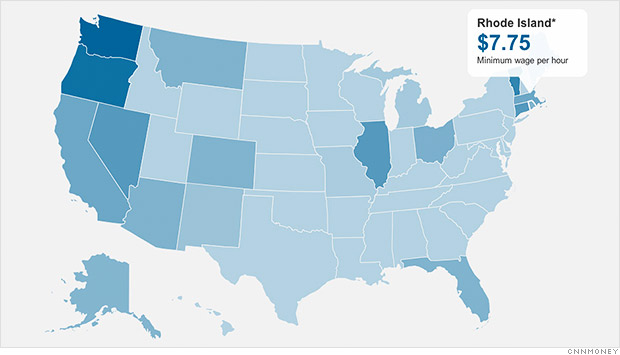
Workers in Rhode Island will see their paychecks grow the most -- by an average of $510 a year for the average worker, according to the National Employment Law Project, a nonprofit advocacy group. The state enacted a law in June raising its minimum wage 35 cents to $7.75 an hour.

In nine other states -- Arizona, Colorado, Florida, Missouri, Montana, Ohio, Oregon, Vermont and Washington -- the minimum wage will jump between 10 and 15 cents an hour, translating to an extra $190 to $410 per year on average, according to NELP. The increases in these states are the result of state "indexing" laws that require automatic annual adjustments to keep pace with rising living costs.

"If you don't do this, the lowest wage earners are going backwards," said Jen Kern, NELP's minimum wage campaign coordinator.

Related: 2013 minimum wage, state by state

An estimated 855,000 workers will be directly affected by the wage changes, while another 140,000 are projected to be indirectly affected by the changes as employers readjust their pay scales to accommodate the new minimum, according to analysis by the Economic Policy Institute.

The new hourly rates will range between $7.35 in Missouri and $9.19 in Washington state, which has the highest minimum wage in the nation.

Workers may not notice much of a change in their paychecks, though, if lawmakers do not extend the payroll tax cut first enacted in 2010. Without the tax cut in place, workers would pay 6.2% instead of 4.2% -- an amount that could wipe out most of the wage boost.

States must pay at least the same as the federal minimum wage, which has been set at $7.25 an hour since 2009 and is not indexed to inflation. That works out to an annual income of about $15,000 -- thousands of dollars below the poverty level for a family of four.

In 2013, 19 states and the District of Columbia will have rates above the federal level.

Related: What happens if the payroll tax cut expires

The increases come at a time when a growing percentage of Americans are employed in low-wage jobs. While the Great Recession saw widespread mid-wage job losses, the majority of jobs created during the economic recovery have been low-wage positions that pay $13.83 an hour or less, according to a NELP report released in August.

Some 72% of the employees set to be affected by the wage increases are adults 20 years or older, according to a NELP analysis.

"That makes it harder to dismiss the minimum wage as some marginal labor standard," Kern said. "In fact, it's a key component of economic recovery because so many of the jobs that are now characterizing our economy are impacted by minimum wage."

Wage advocates like Kern say that increasing minimum wage rates nationwide would stimulate the economy since low-income workers are more likely to spend the extra cash. Business groups counter that increases could create new job losses. To top of page

First Published: December 31, 2012: 5:31 AM ET


22.16 | 0 komentar | Read More
techieblogger.com Techie Blogger Techie Blogger